Showing posts with label japan. Show all posts

12/31/2017

A Daruma and a Happy New Year

A Daruma is a Japanese painted papier-mâché tumbling figurine, and a very popular talisman, if you want to set yourself some goals in life, but have ordinary human limitations and need a bit of encouragement. 

It is very much that kind of time in my life right now, and I have a very small one (but size does not matter) staring at me, as I type this.

The plump, little guy is actually a portrait of Bodhidharma, the monk who founded zen buddhism, and when used as a talisman, it works like this: first you set a specific goal - and yes, it needs to be quite specific, measurable and not vague. Then you go get your Daruma. The Daruma is born with blank eyes, and the next thing you do is fill in the one eye. Place your Daruma somewhere near you, like at your desk or bedside table, where he will look at you, wink-wink, reminding you about your goal. 

And then one day, amazingly, your goal is achieved. And then you get to fill in the other eye. 

They are to some extend a New Years tradition, but not exclusively. The Japanese use them all year round, and they even come in different colours for different themes: gold for financial matters, purple for health, white for love etc. The red, for general good luck, seems to be the popular one!


There is a zen proverb often connected with them:
Nana Korobi Ya Oki,
meaning 'Fall down seven times, get up eight'. 

With that little guy, I wish you all a very happy and healthy New Year, and hope that your dreams will come true, and that you will meet some of your important goals.

Photo credits:
Darumas outside temple: Tony Lopez on Pinterest / Daruma painter: Yuriko Nakao, Reuters

12/08/2017

Japanese Quilt Stars

The Christmas project for you this weekend, are these cool stars. I named them Japanese Quilt Stars, because they look like the stars often used in traditional quilts - and I made you special print-and-cut paper sheets for these, with lots of Japanese vibe. 

They are surprisingly simple modular (6 unit) origami stars - not made from square papers, but from rectangular ones. I have made you some very easy to use sheets for printing and cutting, crop marked for your convenience. With my sheets a star like this is about 18 centimeters across.

My sheet-designs are for printing on both sides, because this design really displays both sides of the paper (and they have a very pretty and completely different looking backside....)

To print these sheets (four small sheets per A4, and you need six units for one star) on both sides, set the printer to print 'page 1 only'. Then grab your sheets from the 'out'-tray, turn them over, put them in the feed tray blank side up, and print again, this time set to 'page 2 only'. I do this all the time, because of my obsession with designing my own origami paper, which - of course - is so much nicer with print in two different designs.

Download my designs right here. I mixed them a lot, as you can see from the backsides, but just one pattern can be varied, in alternating between which pattern you face outwards, in the first fold. 

2021: I have a new location for my downloads, and they are now to be downloaded one page at a time, but for results like in my images, pair the designs like I have, one for the front, one for the back.
A: red waves and dots:  FRONT  /  BACK
B: blue arrows and squares
FRONT  /  BACK
C: pink stripes and trianglesFRONT  /  BACK
D: blue waves and diagonals
FRONT  /  BACK
E: red snow and waves
FRONT  /  BACK
F: blue stars and dotsFRONT  /  BACK

Last but not least: the stars are really not hard to make at all, if you have just a little bit of origami experience, but I have not produced my own tutorial for these, since there is no way I could explain them as well as this patient Indian gentleman on YouTube. 


Happy folding, and have a great weekend.
 

11/21/2017

Air + Paper = Magic

I really love these flimsy, airy, weightless (and some, but not me, would say useless) paper vases or containers designed by Torafu Architects from Japan. They are called Air Vases, and they perfectly illustrate everything I love about working with paper: with a bit of simple intervention, a sheet of paper - delicate and fragile in itself - can become three dimensional, and paper does actually withstand much more tugging and handling than you might think. 

They are not a brand new product, but I was inspired to post them here, because I spontaneously decided that I want one for myself, when I saw them again on Pinterest. A bit of Googling made it clear, that you actually can't buy them that many places - but I came up with one dependable seller in Europe, Design Museum in London. So they are on my Christmas wish list. 

Maybe on yours too? Aren't they cool?


When you buy them, they are a flat disc of paper, with an intricate, concentric pattern of slits that you gently have to manipulate into a vase, rounded or more slender, or perhaps a low bowl shape. 

I love the utter simplicity of this, and also that it is a beautiful thing you could just pop in the mail in an envelope. A great product!

As you can see they have been made in many, many colours and also prints, and are still produced in  Japan. Scan your local market for them, they are available a bit here and there.


5/04/2017

A subterranean must see in Cph: Sambuichi 'the Water'

Very close to where I live, an old system of underground water reservoirs have become an art space, some years back - and every year Cisternerne present a new wild and overwhelming installation, created specifically for this cavern-like dark and wet space, hiding secretly under the park clad hill by the castle, that I have written about before.

This year it is the Japanese architect Hiroshi Sambuichi, who has created the installation. It's called 'the Water'. I went to see it yesterday, and it was so incredibly beautiful. My absolute warmest recommendations, to anyone living in or going to Copenhagen, and it will be there until February 2018, so no need to rush.

Yesterday was a sunny day, and this is a really dark experience, in the literal sense of the word. You crawl down the narrow stairs to an almost physically tangible pitch black nothing at first - all you sense around you is this cool and drippingly wet cavern and an almost overwhelming scent of fresh cedar and cypress wood - and the peculiar, metallic smell of wetness. Blinded by this sudden shift from blazing spring sun to underground cave, I almost crawled into the space. I couldn't see a thing.

But then the most elegant and mysterious world started to materialize before my eyes - like a dark forest or an underwater shrine. The whole space is transversed by elevated, cedarwood walkways in traditional Japanese style, and here and there they lead you to surprising vistas; the lantern lit curve of a bridge, an island of deliciously green fresh moss. Sudden pillars of natural sunlight, led underground by intricate mirrors. And constantly the sound of dripping water.

It was actually a bit hopeless to photograph, except in the parts where you could see, by sunlight - the semi-dark places just couldn't be done any justice by a camera. Go see for yourself, it's great

Links and info after the images.

There were a lot of references to traditional Japanese architecture and to their perception of the elements - and of course some philosophical layers in the whole concept of the installation, which will grow and evolve as nature wills it, in the period it's there. Read about the whole thing here on the Cisternerne (as the place is called) website.

In the heart of the space there is a very, very dark area, where a different kind of rope line the walkways, and seem to border off a kind of center of the grid - where apparently nothing is - but I saw that the rope was the very rough, handmade hemp kind, that you see around shinto temples, and that white strips were hanging from them. I actually had to take a blitz photo to establish this.

There was something that felt very magical about this roped off centre, and I am sure that the kami were abundant there. I could almost not bring myself to leave, but in the end I was freezing (bring a sweater!) and had to get back up into the sun. To be blinded all over again. 


4/13/2017

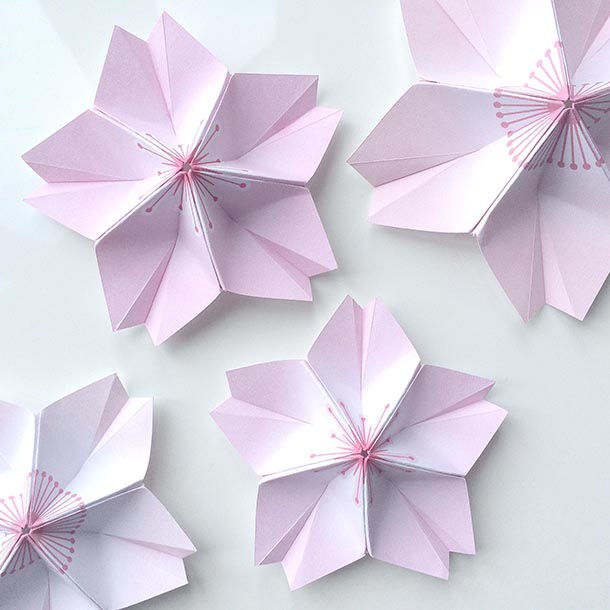
Origami Cherry Blossoms

This year Easter and hanami (Japanese for the season of blossoming cherry trees) coincide. So my paper-diy-project Easter egg gift for you, is a very pretty origami cherry blossom. These are quite large, and would look great as table decorations.

There are countless ways of folding a sakura with five petals, but I did a little research, and I think this one is both pretty, easy to make - and it has all the right characteristics of the cherry blossom, like the star shape and that lovely little dent each petal has. Find the tutorial and my special paper, after the images.


These are modular origami, you need to fold each petal individually, and then assemble them. Once you get the hang of it, you may experiment with the dent (the extra fold in the petal, that gives it shape), you can fold that in many ways - and you could also make flowers with much more than five petals, using the same principle.

You'll need glue for these, otherwise they are all over the place!

I made two slightly different designs, and two sizes : about 12 cm. and 8 cm. - or you could scale the design and make miniature versions of them, they are not complicated to fold. Download and print the special paper, that has two flowers of each size and design, right here: Get the PDF

2021: I have a new location for my downloads, please go here:
Large A
  /  Large B  /  Small A + B


Happy folding, happy Easter, happy Hanami or perhaps just spring!

2/10/2016

Masashi Wakui - Tokyo by night

As anyone who sometimes reads this blog knows, I'm a bit of a Japanophile, or whatever the phrase may be. I have visited Japan only once, about fifteen years ago, and I work hard at convincing my husband who hasn't been there, that we really, absolutely must go, some time. I know both he and my son would completely love it.

I came across this fine photographer - Masashi Wakui - who takes the most stunning pictures of street scenes in Tokyo, especially at night. They show a Tokyo actually very much as I remember it; a lot of hustle and bustle, but also lots of tranquil little alleys, and all of it vibrantly, insanely colorful. Lots of wild contrast; steel-and-glass high rise architecture next to two storey wooden houses, and an ancient shinto temple or perhaps a crazily noisy gaming arcade stuck in between. Rain, umbrellas, neon and red silk lanterns. Gleaming, shiny taxis (the Japanese taxi drivers wear white gloves and polish their cars every day. They also sometimes have little lace doilies on the headrests). It's just a marvellous place, full of wonder and unexpected things.

Taking pictures at night is so hard, I find, and his way of doing it is really seductive. He does a lot of sophisticated afterwork, and if you feel inspired, I came across a Photoshop tutorial for matching his visual style. Maybe worth a try? Interesting, anyway. 

In the meantime, enjoy his beautiful Tokyo.  


(All images copyright Masashi Wakui, from his flickr site)

12/08/2015

More dottyness

I love how a media as Pinterest - a beloved time stealer for anyone who loves great images and cool stuff - is intuitive and just throws random things at you, that are so far from random. I think my love of polka dots introduced me to this shop interior a few days ago, in this particular way. And I had to look it up, and discovered that I had noticed it in several other contexts, like Instagram and so on.

The very nice US fashion brand Opening Ceremony has this shop in Tokyo (opened in 2013). Let me show you a couple of images from the interiors (it's four floors of mega shop, and it also has life size horses as clothes racks and other delightful things). I think I love it. At least I love the staircase. Will absolutely visit it, should I happen to come to Tokyo again any time soon (here's hoping).

Architects and interior designers? No idea. Japanese, and I couldn't figure out who they are. But they must have had a blast.


12/03/2015

Pumpkins. Or Yayoi Kusama by numbers.

Okay, I write a lot about Yayoi Kusama, but the lady fascinates me. Her show at Louisiana is very popular, and Instagram is overflowing with a veritable polka dot frenzy. And I still feel the need to write another blog post about her. Or rather her pumpkins, mostly. 


But first a few words. I like her art in a very simple, straightforward way - it's pretty, it's graphically bold, and it's extremely colorful. So, for me, it's natural to like. I know several people who find her work somewhat shallow and superficial, and yes, she does seem to repeat herself a lot, and no, there is perhaps not a lot to say about dots, come to think of it. Other than the fact that they are pretty, and perhaps resemble the stars of the universe, or perhaps also tiny cells in a Petri dish. The wonders of the small and the huge, etc. etc.

But the show at Louisiana, which is big and cover most of her career in a quite narrative and educational way, made me see something more than the dots. I saw her obsession, and how clinging to the obsession, is her way of staying sane and relatively happy. And how painting is, quite simply, physical therapy. And soothing meditation.

It's not as if these are deep or profound conclusions, but they really set my mind to work, and most especially, at how she has managed the superhuman workload of physically creating her pieces!

As far as I have been able to find out, she does not employ a hoard of assistants - but much is unclear about Yayoi, who is sometimes a bit enigmatic, when answering questions in interviews. In this one, she claims to have done her work herself, and makes a point of it.

I started really looking at her pumpkins. They have become her sort of peace-love-fertility symbol, and are said to be a reference to childhood memories. She grew up in a wealthy family who had a seed- and vegetable business, and has told, somewhere, about feeling guilty about the abundance of food her family had, in war times when the Japanese were starving.

At Louisiana they meet you already outside in bronze supersize, and there are several fine pumpkin works inside - especially a giant yellow/black cabinet, filled with pumpkins. 

(I borrowed the top photo from Designboom, and the cabinet one from snilla.blogspot)

I don't think there is even an official estimate at how many times she has painted, drawn or sculpted this plump vegetable. I just fill with wonder at how much variety she puts into this tedious motif.

Just see how she does the stems in slightly different ways - how she has a variety of ways to do those rows of dots that make up their pattern, and how they vary a lot in their outer shape. But still seems to be the same kind of pumpkin. 

All those little varieties and decisions - about every single one of those pumpkins. I know she did a lot of other types of wildly repetitive and detailed themes, the Infinity nets, for instance, but I just love those pumpkins for their way of occupying her mind for a whole, long lifetime.

So, when I saw a cheap papier-mâché pumpkin in my local hobby shop round Halloween, I just knew I had to make a close study of her pumpkins in the most obvious way: I had to make one myself! And I had to be very faithful to her way of doing them, I had to deliberately copy her, just to feel it.

So, one pumpkin and some paint supplies later, I set to work.

I gave it a few coats of spray paint, and had decided (wisely) to not do the dots with a brush, but rather with Posca markers. I started with the stem, and decided on a 'random dots' type stem. Then I did the tiny ones in the grooves of the pumpkin, and moved on to the central rows of big dots on the swollen parts of the pumpkin. And then moved on to the smaller rows on the sides.

Here are some numbers: After about 1200 hand painted dots and some eight to ten hours of fiddly work doing them - spread out over a few evenings and a Sunday morning - I ended up here. And decided that my pumpkin was done. Yayoi would have kept at it, of course.

So, you might say I took a very small stroll in Yayoi's polka dot shoes. And that was interesting.


11/25/2015

Ruth Asawa

Ruth Asawa (1926-2013) is one of those artists I had never heard of, until I randomly stumbled upon an image somewhere - only to discover that she is a very important American artist, who had an amazing life, made some stunning art and was a tireless activist for education, especially children's arts education. She left quite a legacy in her native California, and in several other places. Perhaps some of my readers have missed out on her, like myself, so here she is - surrounded by some of her signature metal wire sculpture.

She was born in California by Japanese immigrant parents, and was interned during the US/Japanese conflict in World War II, and was subject to much sad racism in her own country - for instance she had to leave teacher college without an actual degree, because no one would hire her for the needed internship. Later she went to art school, and studied under the Bauhaus legend Josef Albers, who inspired her to experiment with commonplace materials. And her one of favorite materials ended up being wire.

I've read somewhere, that her crocheted/woven three dimensional metal sculptures comes from childhood memories of studying insect's wings - and from a later meeting with some basket weavers on a vacation in Mexico, who taught her the particular technique. 


Just see how beautiful they are..... Like pods, fruits, clouds - primitive, in some way. And yet so sophisticated and cool, so very mid century modern. And they look so light! But imagine what they must weigh - and imagine the work involved in making them, and the sheer physical strength she must have had! 

A few more photos of her wire work: a portrait of her from 1952 by Imogen Cunningham and underneath that, her studio with masses of suspended sculptures - and last an installation of hanging pieces, very well lit, so the shadows become an integral part of the work.

Almost as famous as for her artistic work, she was for her many projects with children. 
A most amazing collaboration with children, is the work she did on the San Fransisco Fountain, a massive bronze thing, depicting the history of San Fransisco in bas-relief - mostly based on children's work in play dough, done by kids in her school groups, among those, her own six children. 

There are so many great stories about her, too many for a little blog post like this - but if you feel curious, study a bit more, for instance here, on the official Ruth Asawa website

Last pics: Ruth Asawa working, surrounded by her kids - and the last one is from 1975, from one of her many sculpture workshops with children.