Showing posts with label paper art. Show all posts

11/21/2017

Air + Paper = Magic

I really love these flimsy, airy, weightless (and some, but not me, would say useless) paper vases or containers designed by Torafu Architects from Japan. They are called Air Vases, and they perfectly illustrate everything I love about working with paper: with a bit of simple intervention, a sheet of paper - delicate and fragile in itself - can become three dimensional, and paper does actually withstand much more tugging and handling than you might think. 

They are not a brand new product, but I was inspired to post them here, because I spontaneously decided that I want one for myself, when I saw them again on Pinterest. A bit of Googling made it clear, that you actually can't buy them that many places - but I came up with one dependable seller in Europe, Design Museum in London. So they are on my Christmas wish list. 

Maybe on yours too? Aren't they cool?


When you buy them, they are a flat disc of paper, with an intricate, concentric pattern of slits that you gently have to manipulate into a vase, rounded or more slender, or perhaps a low bowl shape. 

I love the utter simplicity of this, and also that it is a beautiful thing you could just pop in the mail in an envelope. A great product!

As you can see they have been made in many, many colours and also prints, and are still produced in  Japan. Scan your local market for them, they are available a bit here and there.


10/10/2017

Lydia Kasumi Shirreff: Paper engineer


London based paper artist Lydia Kasumi Shirreff calls herself a 'paper engineer', and the complex geometrics of her work, makes that title quite appropriate. And when art and engineering meet, interesting things often happen! 

She does all kinds of abstract, fun and surreal backdrops or mini set designs for commercial photo shoots or editorial illustrations for a long list of very prestigious magazines and clients. In an interview from last year - read it right here - she tells us, when asked why she works in paper, that she just started out as a young designer/sculptor needing a cheap, available and flexible material. And then I suppose she must have stuck with the paper, and has become an absolute virtuoso.

See the magic she works - more links and info after the images.

These cubist, abstract works are just stunning! 

Some of her work is more explosively colorful - and these are just a few examples, visit her website (which I linked to in the beginning of the text), and explore. What I find fun personally, being so fond of paperwork myself, is trying to figure out some of her processes. Not so easy, and very, very impressive, no matter how she has done it.

She has done a lot of figurative set ups for various fashion and lifestyle clients, sometimes so neatly done, that they fool the eye at first (a bit in the style of the amazing German artist Thomas Demand)  but more often like these, where the feel of the paper makes it all pop-arty and candy like. 

On her website she does this great thing - she has a couple of 'behind the scenes' photos, showing her equally impressive work in the photo studio. When you see the shot I will show here, below, it looks almost like a surreal construction made in some 3D rendering program.....

But then check out the next image - and note how the roll of duct tape indicates the size of the small, hanging paper sculptures.

Nice work, indeed, and I love how she shares some of the meticulous preparations for such a single shot. How she works, can also be seen in this little video I found, where she explains a project she made for the eye wear brand Cubitts.


All images: copyright Lydia Kasumi Shireff

2/04/2017

Inspiration: paper and acrylic artwork by Klaus Staudt

It's great when you just stumble upon something at just the exact right moment, so that it sets off a whole stream of ideas, that lead to other ideas, that lead to other ideas...! You know what I mean.

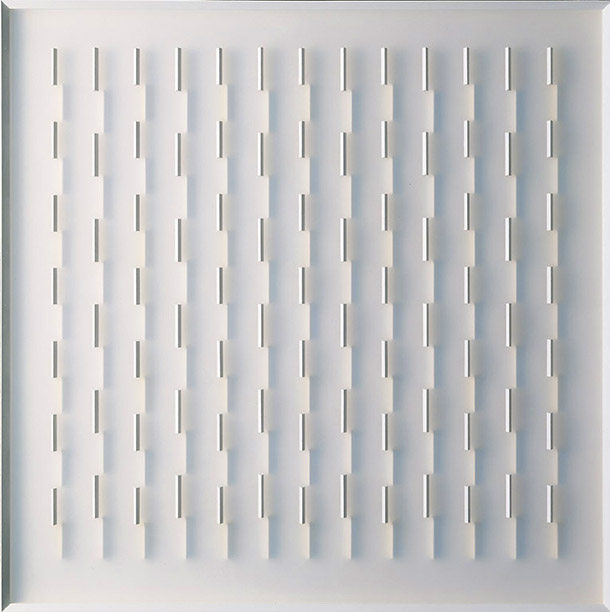
Yesterday I was browsing around on Pinterest, when I came across an image of this minimalist, simple white-on-white relief, apparently cut in some kind of paper. It was so elegant and sharp and precise, and I clicked through to the source and found out that it was made by a rather famous German artist, Klaus Staudt. I had never heart about him, but I googled and clicked around, and found one amazing image after the other. 

I find them very beautiful and inspiring - both as patterns, as paper art, and in how they use shadow almost as a physical material.

Super condensed bio on Klaus Staudt: born in 1932. One of the leading figures in constructivist or concrete art. Famous for his geometrically intricate paper and acrylic reliefs and sculptures and represented in many museums and collections around the world. 

Here is his website (in german) - check out it's super minimal style - and here is an interview from 2015, where the camera does some wonderful close up exploration of his work, while he talks.

His art is the quiet, subdued and obsessive kind, that perhaps does not catch your eye at first glance in some flashy collection of contemporary art, but grows on you when you start to really see it.


12/24/2016

A Christmas card: Snowflakes in New York

Dear readers! I wish you some happy holidays, however you celebrate them and whereever you celebrate them - here it will be done by winding very much down after some busy weeks, no months, for my little family, where work has taken most of our energy. Also some of the energy I usually put into my Christmas DIY postings, I'm afraid - but I hope you have enjoyed the couple I did manage - I have already gotten some very sweet feedback, and that really makes me glad! 

Here is a Christmas card, of sorts. This little story has been on my mind, since I saw a mention somewhere, many many months ago, but it was a winter story - so I forgot about it. And randomly got reminded again via Instagram, the other day! So here goes... 

Everybody knows the iconic Flatiron Building in New York - but you probably have to be around it, at street level, so to speak, to know about the activities in the small glass pavillion (the so-called 'prow') at the bottom. For some time, a local gallery - the Cheryl McGinnis Gallery, has curated art shows in this small glassed-in space. Always colorful, poetic, spectacular and eye catching stuff, it seems. I discovered this via This is Colossal, a rather cool visual arts blog. 

In February 2016, a young New York paper artist, Chelsea Hrynick Browne, made the most fantastic installation of literally thousands of small kirigami papercut snowflakes, suspended on lengths of nylon string - to make the space look like a rainbow colored blizzard was happening. 

Here it is, in an actual blizzard - photographed by Michele Palazzo (more photo credits at the end).

I do have a soft spot for anyone who gets so obsessive with their scissors, as you may know. Check some of my other posts tagged paper artist!

I also love snowflakes in windows (discover some of my earlier mentions here!)

Chelsea Hrynick Browne is interested in mathematics, patterns and repetitions - and I can't imagine how long it takes her to complete a task like this. All the snowflakes you see, are double layered (apparently laminated in some kind of thin, shimmery film), and very detailed. They are all cut by hand, by her.

Here she is, at work, hanging the installation - and a couple of images from her Instagram shows some more detail of how her square motifs typically look.  


Photos: Street evening photos from: untappedcities.com.
Portrait and details from Chelsea Hrynick Brown's Instagram
Detail of flake hanging in window from: fibonaccisusan.com

Just for fun, I'll wrap up this post with a nice old photo: the Flatiron Building with it's distinctive prow, just seen at street level, at the 'point' af the building - looking probably much as it does today. 

5/12/2016

Spring favorite # 2: The Flower Queen

Marianne Eriksen Scott-Hansen is a Danish fashion artist / designer / stylist / general creative explosion - known by anyone who has followed experimental fashion here in DK for the past two decades. She works in all kinds of media, but her almost superhuman ways with the scissors are somehow central to much of what she does. When you read interviews with her, she often explains how she works intuitively, with very few templates, work drawings or such. She simply lets the scissors do the talking, and incredible things happen. 

At the moment she works almost entirely in paper, and her wild, textural visual style has really taken off in her current project: doing enormous flower installations in cheap tissue or crêpe paper. She emphasizes how she insists on working in the standard materials her local paper shop stocks (although the amounts of paper that she uses are not quite standard - she must be a wonderful customer for that paper shop!!), and how she does everything herself and by hand. 

I am simply breathlessly impressed and full of awe and wonder! It is stunning and abundant. The workload almost incomprehensible - and, it's all from plain paper and a pair (or several pairs) of ordinary scissors. Paper truly is a magic material (as I keep insisting on).

Please enjoy these few pictures of Marianne Eriksen Scott-Hansens Easter decor in the Royal Copenhagen flagship store - and, I think, from a backdrop for the ELLE style awards (just two of her many, many supersize flower extravaganzas).

All photos are from her instagram, where you should follow her and fall in love with her work as well.


10/21/2015

Paper necklaces by Catrine Berlatier

I've always been wanting to make some kind of paper jewellery, but I just haven't found any technique or come up with anything that seems to have the kind of detailing and strength, I think it would need.

It's no fun to make something that falls apart, or can't withstand a bit of handling. But still, I know that paper is this really, really strong material, if you treat it the right way.

And then, as I was browsing away on Instagram, I came across something: these beautiful rope or concertina paper necklaces by a woman named Catrine Berlatier. She is a French jewellery maker, living in Melbourne, Australia, where a local jewellery gallery - e.g.etal - sells her work.


I think they are fantastic - they look strong and durable, and yet you feel that they must be light, flexible and nice to the touch. The weaving or folding technique is simply beautiful, and I have googled like a crazy person to identify it, because I would so love to try it. It looks like a lot of work, and her level of finesse I am not aiming for - but I'd love to give it a go. 

If anyone reading this can help, I would be thrilled! What is this kind of weaving / folding called?

But back to Catrine Berlatier; she makes her folded necklaces from all sorts of discarded paper, old books etc. (for instance old atlases  - see the first necklace below).


There is a bit of an African vibe about them, that I really like - I'm a big fan of Masai and Turkana jewellery, for instance - and they are just so well made, you can really see her skill and craftsmanship.

Her necklaces are for sale here, if you have (quite a few) Australian dollars to spare!

(all photos here are by Catrine Berlatier and e.g.etal)
 

8/12/2015

Irving Harper

A few days ago, Irving Harper, one of my new found design heroes, died at 99, in his home in Rye, New York - surrounded by a lifetimes worth of work from his hands; and his house was, quite literally, filled with something that interests this blog particularly - his fantastic paper sculptures and model experiments.


Not many people in Denmark know of Irving Harper. I discovered him by chance, browsing around on mid-century modern Pinterest boards. In US he has become the widely acclaimed designer of that particular era, that he deserves to be - and now I am going to pay him a little tribute as well, and here's hoping that some of you feel like getting to know this abundant, wonderful design mind a bit better. 

He was the man behind lots of iconic designs from the era, mainly as an employee for George Nelson and Herman Miller (many of these have just lately become credited to him), but he worked for other manufacturers as well, and in many fields of design. He did lamps, furniture, kitchenware, textile design and graphic design. He made Herman Millers logo and had great impact as an design director for the company

He loved modelling in paper, he found paper to be a versatile, inexpensive, quick medium to work in, and one that only required a knife and some glue. And his work in paper - which filled his house to the brim - was simply amazing. It leaves me breathless. 

Here is a little taste. I will end the post with some nice links, also to a couple of very fine YouTube videos, if you have gotten curious. 


Images for this post are very hard to credit - they seem to have been reposted over and over again.
Some are by Leslie Williams, some are from Elle Decoration, some unknown by me. 

Some may be from this 2013 book: Irving Harper: Works in Paper.

Here are two fine videos from YouTube: